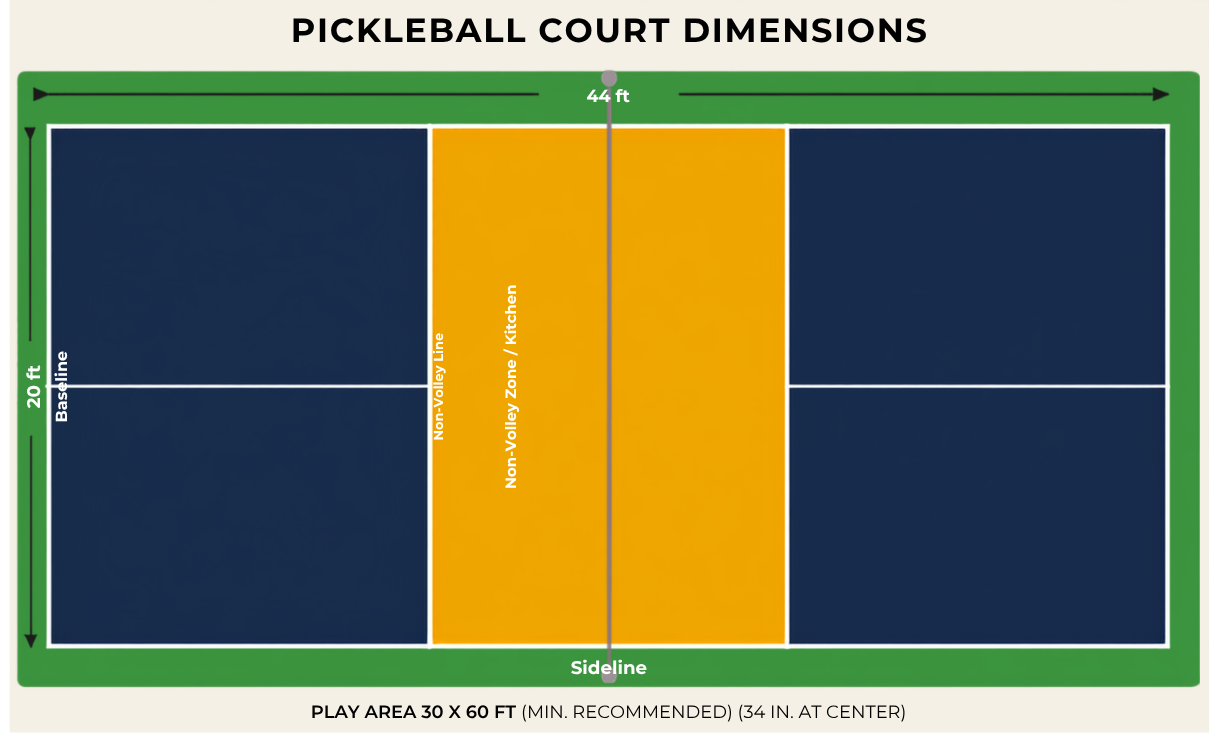
A pickleball court is 44 ft long and 20 ft wide - the same footprint as a doubles badminton court, and the same dimensions whether you're playing in Austin, Cancún, or anywhere in between. The key zone to know is the Kitchen (Non-Volley Zone), which runs 7 ft on each side of the net.
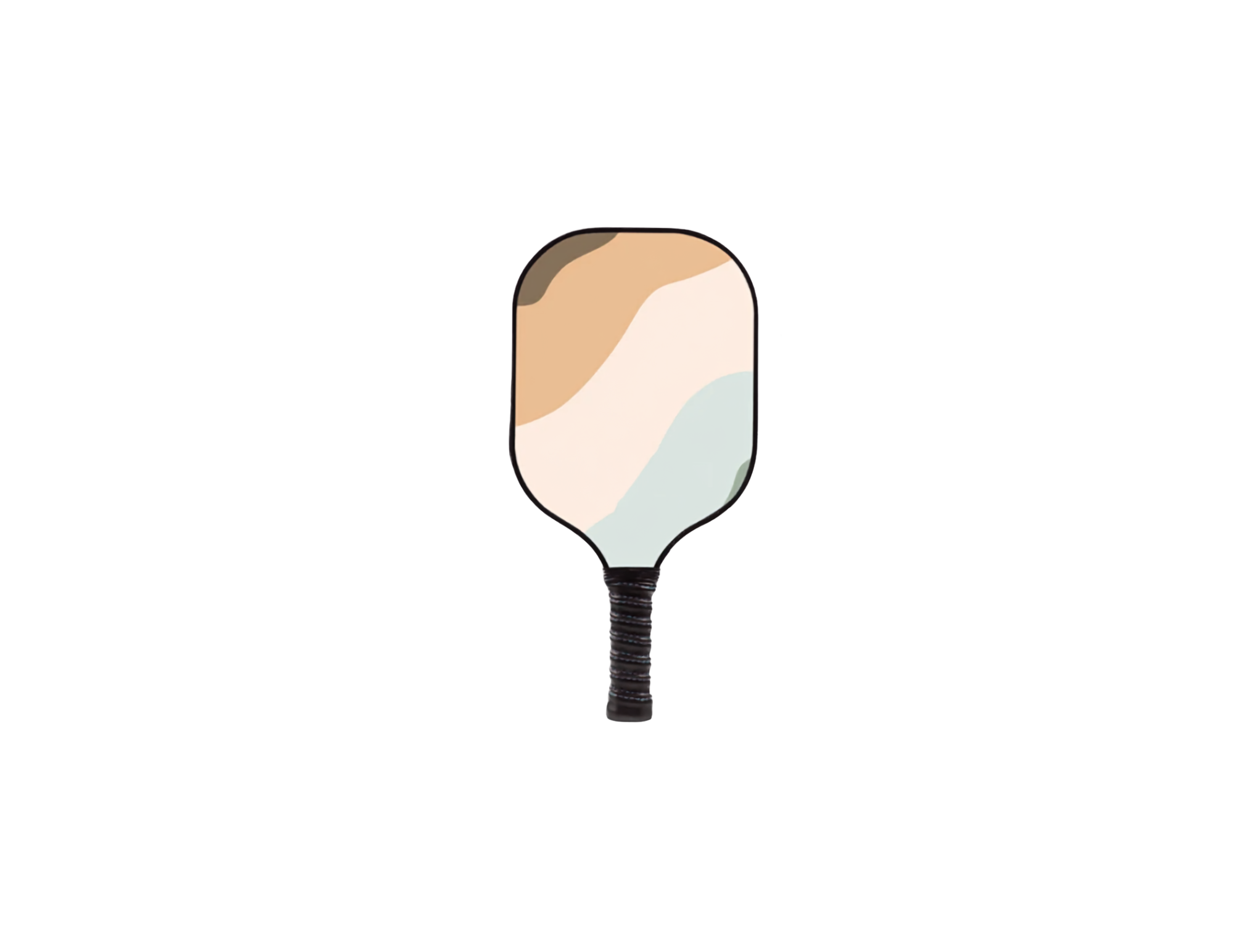
- The Paddle Solid face - no strings. Made of composite, graphite, or wood. Max 17" in combined length and width. Any grip size works.
- The Ball Plastic, perforated (think wiffle ball). Outdoor balls have smaller, harder holes; indoor balls are softer with larger holes.
- Footwear Court shoes with lateral support are ideal. Running shoes are fine to start - just avoid cleats or open-toed shoes.
Serving is the most rule-specific part of pickleball. Nail these and you'll avoid a lot of early frustration - the rules are the same from your home courts to any court you roam to.
- Underhand volley serve Paddle contact must be below the wrist, with the paddle head below the wrist at impact. No overhead serves. Alternatively, a drop serve (bounce the ball and hit it after it bounces) is also legal with fewer restrictions.
- Stay behind the baseline Both feet must be behind the baseline when you serve - you can't step on or over the line before contact.
- Diagonal, past the kitchen The serve must land in the opposite diagonal service box and must clear the kitchen line completely. Landing in the kitchen is an immediate fault.
- One serve attempt Unlike tennis, you get one serve only. If the ball clips the net and lands in the correct box - called a "let" - you re-serve. (Note the hyphen: re-serve means serve again.)
- Server rotation in doubles Both partners serve before the serve switches to the other team, except at the very start of the game when only one player serves first.
The Non-Volley Zone - nicknamed "the Kitchen" - is the 7-foot zone on each side of the net. This is the rule that catches nearly every new player off guard.
❌ You CANNOT
Volley (hit the ball out of the air) while standing in the kitchen or touching the kitchen line. Applies even if momentum carries you in after a shot.
✅ You CAN
Step into the kitchen to hit a ball that has already bounced in there. Just re-establish both feet outside before volleying again.
❌ Watch your momentum
If your follow-through carries your foot into the kitchen after a volley - that's a fault, even if you hit the ball from outside the zone.
✅ Kitchen strategy
The goal is to get to the kitchen line. Controlling the net from just outside is where games are won. Every Roamer learns this lesson fast.
This rule is unique to pickleball and it levels the playing field. When the ball is served, it must bounce once on each side before either team can volley.
In practice: the receiving team must let the serve bounce, then the serving team must let the return bounce - only after both bounces can either side start volleying out of the air. This stops the server from rushing the net and dominating instantly.
Pickleball uses side-out scoring - only the serving team can score a point. If the receiving team wins the rally, they earn the serve back but no point. Some recreational venues use rally scoring (a point on every rally); check before you play. Tournament standard is side-out to 11, win by 2.
(doubles)
In doubles, call three numbers before every serve: your score – their score – server number (1 or 2). "4 – 2 – 1" means your team has 4, they have 2, and it's the first server's turn. In singles, just two numbers.
Practice: What do you call?
A fault stops play and hands the serve (or point) to the other side. These are the ones you'll see most often on any court, anywhere.
- Ball lands out of bounds Any shot outside the court lines - including landing in the kitchen on a serve - is a fault.
- Ball hits the net Doesn't clear the net? Fault. A serve that clips the net and lands in the correct box is a let - you re-serve.
- Volleying from the kitchen Hitting out of the air while in the NVZ or touching the kitchen line - including on the follow-through.
- Violating the two-bounce rule Volleying either the serve or the return before it bounces once on your side.
- Bad serve Overhand, landing out of bounds, or stepping on the baseline before contact.
- Ball hits you or your clothing If the ball touches any part of your body or clothing other than the paddle, it's a fault.
Quick check: fault or not?
You step into the kitchen and volley the ball out of the air. Fault?
You volley from just outside the kitchen, but your momentum carries your foot in after contact. Fault?
The ball bounces in your kitchen. You step in and hit it. Fault?
Pickleball has a culture that makes it special. Every Roamer, from first-timer to seasoned traveler, plays by these unwritten rules.
- Tap paddles after the game Win or lose, meet at the net for a quick tap. It's the pickleball handshake - you'll find it on every court you ever visit.
- Call your own lines honestly If you can't tell if a ball was in or out, it's in. Only call shots on your side of the court.
- Return stray balls safely Wait for a rally to finish before rolling a ball back onto a neighbor's court.
- Respect adjacent courts Keep noise and movement to a minimum when nearby courts are mid-rally.
- Call the score before every serve Don't stall, but make sure everyone's on the same page before you hit.
- Cheer good shots - on both sides The pickleball community is genuinely welcoming. If you're playing with beginners, be the player you wished you'd had when you started.
Tick each one as you nail it. Your progress is saved to this device so you can come back and keep going.
Rules Rookie badge unlocked! You're ready to roam. Join the community →
Get the Free Cheat Sheet
All the rules, scoring, and kitchen basics on one printable page. Perfect for your first open play session.