How to Play Pickleball
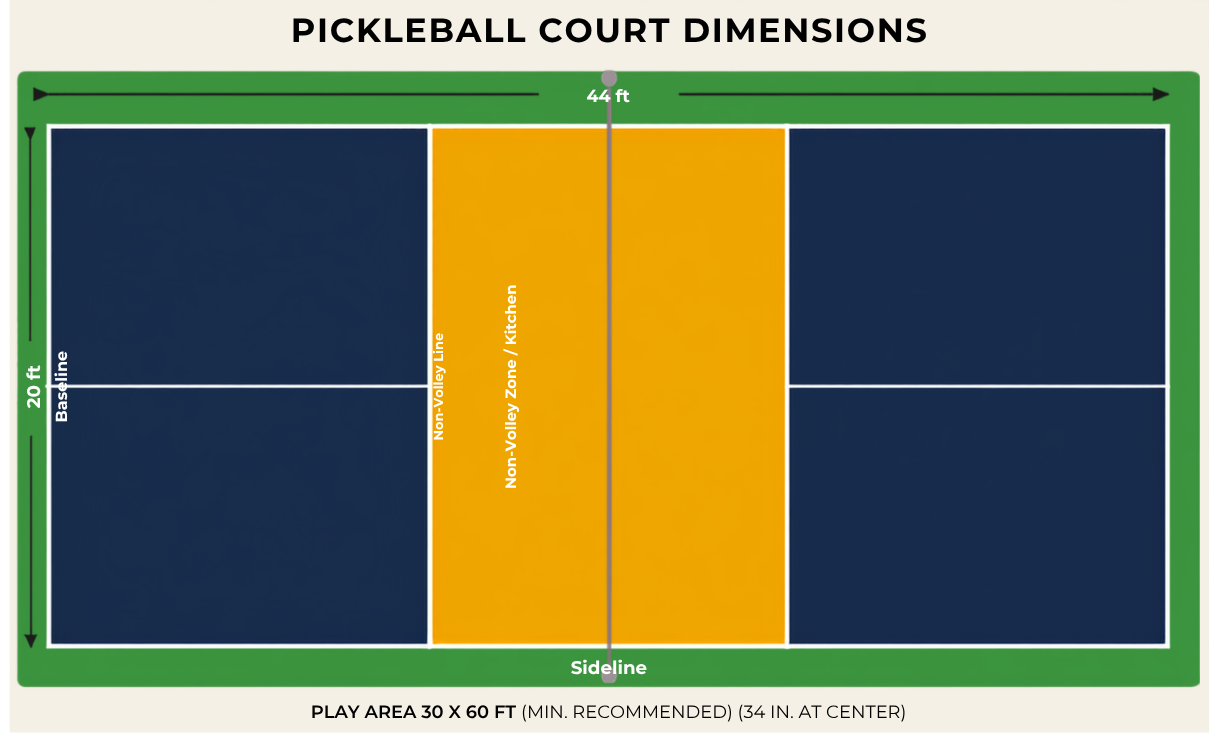
Pickleball is a paddle sport played on a court roughly the size of a badminton court (20 ft × 44 ft) with a 36-inch net at the sidelines and 34 inches at the center. It can be played as singles or doubles, though doubles is by far the most common format.
Players use solid paddles (originally wood, now composite or graphite) to hit a lightweight perforated plastic ball — similar to a wiffle ball — back and forth over the net. The goal is to keep the ball in play and force your opponents into a fault.
The Basic Flow of a Rally
- Serve: The serving team starts every rally with an underhand diagonal serve from behind the baseline.
- Double bounce: The receiving team must let the serve bounce, then the serving team must let the return bounce before either team can start volleying.
- Rally: After the two mandatory bounces, either team can volley the ball out of the air or let it bounce — except from inside the kitchen (non-volley zone).
- Fault: A fault ends the rally. Only the serving team scores a point on a fault by the other team.
The Kitchen Rule in Pickleball
The kitchen rule is the most misunderstood rule in pickleball. "The kitchen" refers to the non-volley zone (NVZ) — a 7-foot zone on each side of the net marked by a line parallel to the net.
What Counts as a Kitchen Violation?
- Volleying while in the kitchen: If you step on or over the kitchen line and hit the ball before it bounces, that's a fault.
- Momentum carry-in: If you volley near the kitchen line and your momentum carries you into the zone after the hit — even if the ball is already gone — it's still a fault.
- Any body part counts: A toe touching the kitchen line while volleying is a fault. The kitchen line itself is part of the zone.
What Is Allowed in the Kitchen?
- You can enter the kitchen to play a ball that has already bounced.
- You can stand in the kitchen anytime you're not volleying — it's common to hang out there during dinking rallies.
- You just need to make sure both feet are outside the kitchen before you volley again.
Pickleball Scoring Rules
Pickleball uses rally scoring in some recreational formats, but the traditional and official format is side-out scoring: only the serving team can score a point.
The Three-Number Score Call (Doubles)
In doubles, the score is always called as three numbers before each serve:
How Serving Rotates
- Each team gets two serves — one per player — before a side-out occurs.
- Exception: at the very start of the game, the first serving team only gets one serve (server 2), to balance the advantage of serving first.
- When a side-out happens, the serve switches to the opposing team and the player in the right service court serves first.
- Players on the serving team switch sides (right/left court) every time their team scores a point.
Pickleball Serving Rules
The serve sets every rally in motion. Get these rules right and you'll avoid the most common beginner faults.
- Underhand swing only: The paddle must contact the ball below the server's waist. The arm must swing in an upward arc.
- Diagonal cross-court: The serve lands in the diagonally opposite service box — right-court server to receiver's right court, and so on.
- Clear the kitchen: The serve must land past the kitchen line. Landing on the kitchen line is a fault.
- Feet behind the baseline: Both feet must be behind the baseline during the serve. One foot may be in the air, but neither can touch the baseline or court.
- One attempt: Only one serve attempt is allowed per rally — no second serves like in tennis.
- Let serve: If the ball clips the net and still lands in the correct service box, it's a "let" and the serve is replayed.
The Double-Bounce Rule
The double-bounce rule (officially called the two-bounce rule) is what makes pickleball different from other paddle sports and prevents net-rushing on the serve.
Step by Step
- Serve: Server hits the ball underhand cross-court.
- Bounce #1: The receiving team must let the serve bounce before returning it.
- Bounce #2: The serving team must let the return bounce before hitting it.
- Open play: After both mandatory bounces, either team can volley or play off the bounce — as long as they respect the kitchen rule.
This rule is why you see both teams move toward the kitchen line after the opening exchange — once the double bounce is complete, the net position becomes the strongest place to play from.
Common Faults in Pickleball
A fault ends the rally. If the serving team faults, the serve moves to their partner (or, if both servers have faulted, to the other team). If the receiving team faults, the serving team scores a point.